Your YouTube Views Jumped on 24 August — Here's Why
Short answer: from 24 August 2026 YouTube counts a public view the moment playback starts, with no minimum watch time. Your numbers went up because the measuring stick changed, not because more people watched. Your earnings are unaffected — money still runs on a different metric.
If you opened Studio and found your view counts climbing faster than usual, nothing is broken and nothing was inflated artificially. YouTube changed the definition.
1What actually changed
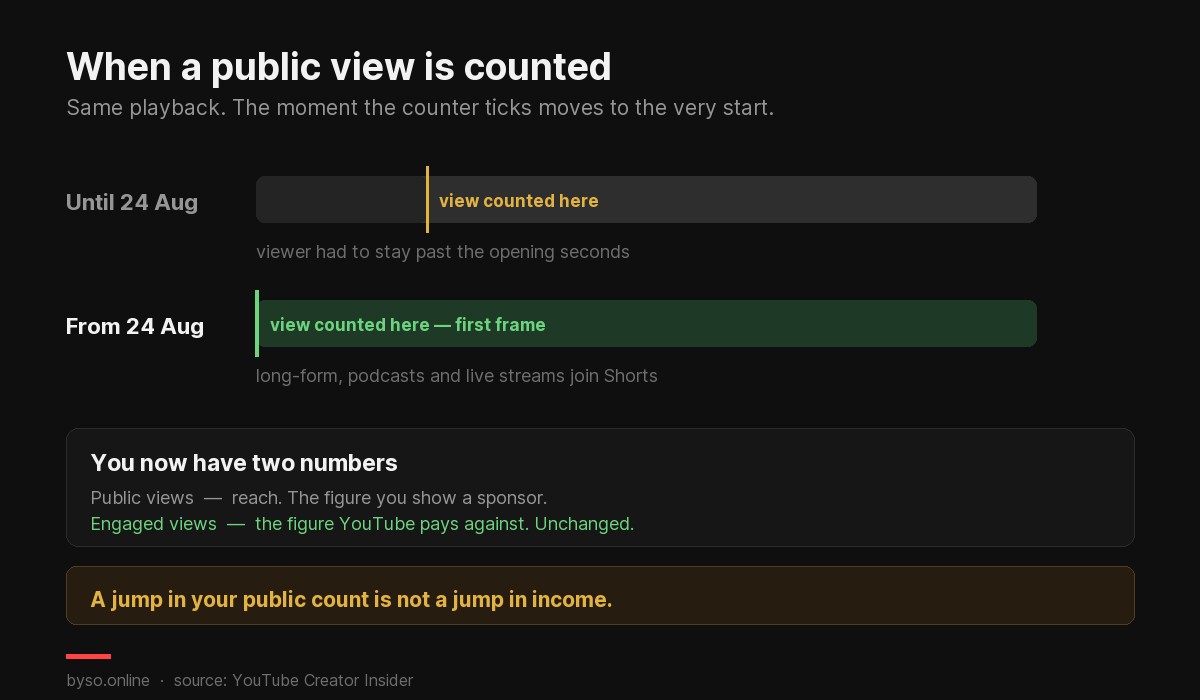
Previously a public view required the viewer to stay past the opening seconds. Now it registers from the first frame.
The change covers long-form videos, podcasts and live streams. Shorts already worked this way — they moved to the same model last year, and this brings everything else in line.
YouTube's stated reason is consistency: until now a "view" meant one thing on Shorts and something else on a long video, which made the two impossible to compare. The secondary reason is commercial — one comparable number is easier to put in front of a sponsor.
2How much did views go up? There's a number now — here's what it's worth
Removing the watch-time requirement means more plays qualify. The size of the jump depends on how many people used to click away in the first seconds — which varies by channel, format and traffic source.
When this article first ran we said nobody could give you a figure. Since then one has been published and widely repeated: public views running roughly 30% above engaged views, from ad platform Agentio. It's the best estimate available, and it is worth understanding precisely what it is before you quote it.
| Vertical | Estimated gap |
|---|---|
| Technology · Fitness | +36.5% |
| Fashion & Beauty | +35.2% |
| Lifestyle | +33.4% |
| Food & Drink | +32.0% |
| Education | +29.0% |
| Entertainment & Culture | +27.4% |
| Gaming | +27.0% |
Channel size moves it too: smaller channels (10–50K median monthly views) come out at +32%, large ones (300K+) at +27%. Which fits — a bigger channel's traffic is already broader, so it carries more early drop-off before the change.
What that 30% actually rests on. It is a projection, not a measurement of what happened on 24 August. The analysis covers 35,800 long-form videos from June–July 2026 — before the change — and models the gap by applying an assumed 30-second threshold for what used to count as a view. YouTube has never published that threshold. Its own definition says only "clicking to watch or watching past the initial seconds" — no number, apparently on purpose. If the real threshold is shorter than 30 seconds, and "initial seconds" suggests it may well be, the true gap is smaller than 30%.
One figure in that research is on firmer ground. For Shorts the gap comes out at +65%, measured across 550 organic Shorts — and there it isn't modelled, because YouTube already reports engaged views for Shorts. That's two published numbers compared, not an assumption applied to old data.
So: use ~30% as a rough order of magnitude for what to expect on long-form, quote it with the caveat attached, and treat your own before-and-after in Studio as the only figure that describes your channel — with the care set out below.
3What did not change: the money
YouTube says engaged views remain the metric behind monetization and revenue calculation across all videos, including qualification for Shorts ad and subscription revenue sharing. An engaged view means the viewer stayed past the first frame and the opening seconds — the standard that applied before this change.
So you now have two numbers doing two jobs:
| Metric | What it is | What it's for |
|---|---|---|
| Public views | Counted from the first frame | Reach. The number on the watch page, and the one to show a sponsor. |
| Engaged views | YouTube's wording: "clicking to watch or watching past the initial seconds" | Earnings and Partner Program qualification. Available in Studio. |
Note the wording on that second row. It's a quote, and it contains no number — YouTube states the threshold as "the initial seconds" and does not say how many. That vagueness is why every published estimate of the size of the jump has to assume a figure, and why none of them can be checked.
The practical consequence is worth stating bluntly: a bigger public number does not mean a bigger payment. If your views climbed 30% on 24 August and your revenue didn't move, that is the system working as designed, not an error to report.
4Old videos now have a mixed counter
Historical totals were not recalculated. A video published before 24 August keeps everything it had accumulated under the old rule, and every view after that date is added under the new one.
That leaves those videos with a counter built from two different definitions stacked together. It's fine as a running total, but it makes any before-and-after comparison on the public number meaningless.
For comparisons that hold, use engaged views in Studio. Since it's the same standard on both sides of the change, it's the only metric that stays consistent.
5What to do about it
- Don't celebrate, and don't panic. The step change in your chart on 24 August is the definition moving, not your performance.
- Switch to engaged views for any trend analysis. Anything you track month over month should move to that metric now, or your data has a seam in it.
- Update what you tell sponsors. The higher public number is legitimate and now comparable across formats — but if you quoted reach before the change, be ready to explain why the figure moved.
- Ignore it for monetization planning. Partner Program thresholds and revenue are unaffected.
The metric changed; what earns attention didn't. BYSO writes the title, description and tags from your video and generates click-ready thumbnails — the things that decide whether anyone presses play at all.
Try BYSO free →Sources
The rules here come from YouTube's own material: the Creator Insider video Update to How Public Views Are Counted on YouTube published 17 August 2026, the accompanying announcement in the YouTube help community, and YouTube's post explaining engaged views (19 August 2026), which is the source of the quoted definition and of the fact that no threshold is published.
The size estimates are not YouTube's. They come from ad platform Agentio, announced 20 August 2026, based on 35,800 long-form videos from June–July 2026 with an assumed 30-second engagement threshold, plus 550 organic Shorts for the Shorts figure. We report them because they are the best available, and we flag the assumption because it is load-bearing.
FAQ
Why did my YouTube view count suddenly go up?
From 24 August 2026 a public view is counted from the first frame, with no minimum watch time, on long-form, podcasts and live streams. More plays qualify, so the number rises.
Does the new view count mean I earn more?
No. Engaged views remain the metric behind earnings and Partner Program qualification, and that standard is unchanged.
How much did YouTube view counts actually go up?
The most quoted figure is ~30% for long-form, from ad platform Agentio — but it is a projection, not a measurement: 35,800 videos from June–July 2026 (before the change), modelled with an assumed 30-second threshold that YouTube has never confirmed. By vertical it ranges from +27% (gaming) to +36.5% (technology, fitness). The firmer figure is Shorts at +65%, measured across 550 videos, where no assumption is needed.
What is the difference between public views and engaged views?
Public views count from the first frame and represent reach. Engaged views require the viewer to stay past the opening seconds and are what YouTube pays against.
Were my old videos recalculated?
No. They keep their existing totals; only new views follow the new rule. That makes their public counter a mix of two methods.
How do I compare performance before and after the change?
Use engaged views in Studio — it's the same standard before and after the change.
Related: the bigger change for your income is the Partner Program overhaul from 1 February 2027, where the entry bar doubles and Shorts revenue gets a 10 million view floor. Both thresholds are measured on the monetization metric, not the new public counter.