YouTube Partner Program Changes 2027: Every New Threshold Explained
Announced 10 Aug 2026YouTube is changing the Partner Program — by its own description, the first significant change since 2018. The new rules take effect 1 February 2027, and existing partners must accept updated terms in Studio by 31 January 2027.
If you read one paragraph: if you're already in the Partner Program, the new entry thresholds don't apply to you — but you do have to click accept in Studio before the end of January 2027. The two changes that actually bite are the doubled entry bar for newcomers and a 10 million Shorts views requirement to keep earning ad and subscription revenue on Shorts.
1Getting in gets twice as hard
The subscriber requirement stays where it has been for years. Both of the alternative thresholds double.
| Requirement | Now | From 1 Feb 2027 |
|---|---|---|
| Subscribers | 1,000 | 1,000 |
| Qualified public watch hours | 4,000 / 12 months | 8,000 / 365 days |
| or qualified Shorts views | 10M / 90 days | 20M / 90 days |
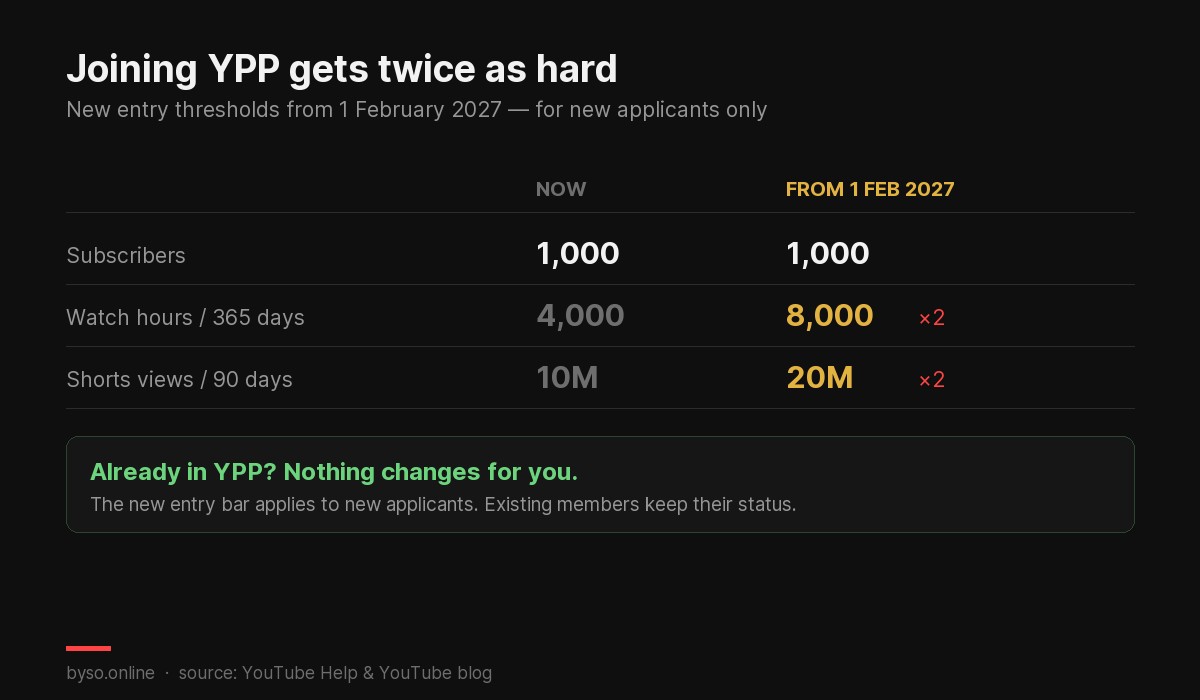
You still only need to clear one of the two routes, alongside the 1,000 subscribers. But whichever route you were on, the distance just doubled.
The honest read: this is a meaningful barrier for channels currently a few months away from monetization. If you are at 3,000 watch hours today and expected to cross 4,000 by winter, you now need 8,000 — and the clock runs out on 1 February.
The word "qualified" is doing a lot of work
Both thresholds say qualified, and that word excludes more than most creators assume. YouTube's eligibility page spells it out:
- Qualified watch hours come from public long-form videos. Private, unlisted and deleted videos don't count, and neither does watch time bought through ad campaigns.
- Qualified Shorts views come from public Shorts shown in the Shorts feed. Ad campaigns and Image Posts are excluded.
The trap worth knowing: watch time from Shorts viewed in the Shorts feed does not count toward the watch-hours threshold. A channel racking up Shorts minutes isn't quietly building toward the 8,000 hours — those two routes are separate, and time spent on one doesn't move the other.
2Already in the programme? You're grandfathered
This is the question everyone asks first, and the answer is reassuring: YouTube says the update does not affect creators already in the Partner Program. You are not re-tested against the new numbers.
One thing you must actually do: accept the updated terms in YouTube Studio by 31 January 2027. Miss it and, from 1 February, you stop earning from the affected modules — the Watch Page Monetization Module, the Shorts Monetization Module and, where it applies, the Commerce Product Module. This is a click, not a re-application, but it's a click with a deadline.
3Shorts revenue now has a 10 million view floor
This is the change with the widest practical impact, and it's separate from joining the programme.
From 1 February 2027, earning ad and subscription revenue on Shorts requires 10 million qualified Shorts views over the previous 90 days. That is roughly 110,000 Shorts views a day, sustained.
What happens if you're below it, which most channels will be:
- You stay in the Partner Program — this is not a removal
- You keep earning on long-form video as before
- You stop sharing Shorts ad and subscription revenue until you cross the threshold again
So it is a rolling window, not a one-time judgement. Cross it in a good quarter and you're back in.
4From 24 August, a "view" stops meaning what it did
This is a separate announcement, but it lands right on top of the threshold above, and the two will be confused constantly.
From 24 August 2026, YouTube counts a public view from the first frame — the moment playback begins, with no minimum watch time. It applies to long-form, podcasts and live streams, bringing them in line with Shorts, which have worked this way since last year.
Two consequences follow immediately:
- Public view counts will go up. Removing the watch-time threshold means more plays qualify. How much depends on how many viewers used to bounce in the opening seconds.
- Nothing is recalculated retroactively. Older videos keep the total they had, but new views on them follow the new rule — so their counter becomes a blend of two methods, and comparing across 24 August won't be meaningful.
The part that matters for money: this does not change what you earn. YouTube says engaged views — where the viewer stayed past the first frame and the opening seconds, which is how views were counted before — remain the metric behind monetization and revenue calculation, including qualification for Shorts ad and subscription revenue sharing. The engaged view count is available in Studio, and it's what to use when comparing performance across the change.
So from 24 August you effectively have two numbers. The public one is reach — the figure to show a sponsor. The engaged one is the figure YouTube pays against.
We unpack that change on its own in why your view count jumped on 24 August. Short version of the misunderstanding worth avoiding: a jump in your public view count is not a jump in income. The ruler changed, not the performance. And the 10 million Shorts threshold from the previous section is a monetization threshold — it isn't measured by the new public counter.
5Premium Lite pays creators a bigger share
Premium Lite — the cheaper, limited tier — is expanding to every country where YouTube Premium is offered. The revenue split differs from full Premium:
| Subscription | Share to the creator pool |
|---|---|
| YouTube Premium | 30% of net revenue |
| YouTube Premium Lite | 60% of net revenue |
In both cases the pool is then divided 55% to long-form videos and 45% to Shorts.
The higher Lite percentage sounds generous, and mechanically it is — but note it's a share of a cheaper subscription, so a bigger slice of a smaller pie. Whether that nets out positively depends on how many viewers move to Lite versus how many are new subscribers who wouldn't have paid at all.
6New ways to earn for smaller channels
Alongside the Shorts threshold, YouTube says it is adding incentives aimed at channels below it — YouTube Shopping bonuses, brand deal incentives, and boosts tied to starting or growing trends.
Detail here is thin so far. Treat the headline as confirmed and the mechanics as not yet documented; we'll update this article when the specifics land rather than guess at them now.
7Who should actually worry
Sorting the noise, in descending order of how much this should change your plans:
- Approaching monetization on watch hours. You have until 31 January 2027 at the current 4,000-hour bar. That deadline is now the single most valuable thing on your calendar.
- Approaching monetization via Shorts. Same deadline, and your bar goes from 10M to 20M — the harsher of the two increases in relative terms.
- Earning meaningfully from Shorts today. Check whether you clear 10M qualified Shorts views per 90 days. If you're near the line, that revenue is now variable.
- Everyone already monetized on long-form. Accept the terms in January. Otherwise carry on.
- Everyone else. This news does not change what you should do this month, which is still to make videos people click and finish.
If the deadline is what matters to you, the fastest lever is click-through: better titles and thumbnails move watch hours more than anything else you can change this week. BYSO writes the title, description and tags from your video and generates click-ready covers.
Try BYSO free →Sources
Every figure above comes from YouTube's own material, not from secondary reporting: the announcement on the YouTube blog, the help page on changes to Partner Program terms, and the current thresholds on the YPP eligibility page. Where the two sources phrase the deadline differently — the blog gives 1 February as the effective date, the help page gives 31 January as the acceptance deadline — we've used the help page's precise wording.
FAQ
What are the new YPP requirements in 2027?
1,000 subscribers plus either 8,000 qualified watch hours in 365 days or 20 million qualified Shorts views in 90 days, from 1 February 2027. Both alternative thresholds double; subscribers are unchanged.
Will I lose monetization if I'm already in?
No — the entry change doesn't apply to existing members. But you must accept the updated terms in Studio by 31 January 2027 or the affected modules stop earning from 1 February.
What is the 10 million Shorts views rule?
From 1 February 2027 you need 10M qualified Shorts views per 90 days to earn ad and subscription revenue on Shorts. Below it you stay in YPP and keep long-form earnings.
When is the deadline to accept?
31 January 2027, in YouTube Studio. New terms take effect 1 February 2027.
How much do creators get from Premium Lite?
A pool of 60% of net Premium Lite revenue, versus 30% for standard Premium. Both are split 55% long-form and 45% Shorts.
My views jumped after 24 August — am I earning more?
Almost certainly not. Public views now count from the first frame across all formats, so the totals rise. Earnings and Partner Program qualification still run on engaged views — the older standard, unchanged. Compare periods using the engaged views metric in Studio.
Do Shorts views count toward the watch hours?
No. Watch time from Shorts in the Shorts feed doesn't count toward qualified watch hours — those come from public long-form videos only. The two routes are separate.
If Shorts are your route: the cover frame decides whether people click from search and your channel page — see our Shorts thumbnail guide and the design rules for vertical covers. And you can check any video against YouTube's documented rules with our free video SEO checker.