Do YouTube Tags Matter? We Measured 908 Popular Videos
Short answer: YouTube says tags barely affect discovery — and creators ignore that advice almost universally. 93% of popular long-form videos still fill tags in, using a median of 19 tags and 373 of the 500 available characters. Meanwhile 61% of Shorts have no tags at all. Both facts are worth understanding before you spend another twenty minutes on a tag list.
Every article about YouTube tags repeats the same two claims: that tags are a secret ranking lever, or that tags are dead. Neither one gets checked against anything. So we checked.
We pulled the tags from 908 of the most-viewed videos across ten niches using the YouTube Data API, and measured what creators actually do — not what advice columns say they should.
1What we measured, and what we didn't
Sample. 908 unique videos, collected 30 July 2026 via the YouTube Data API, across ten niches: gaming, cooking, fitness, tech reviews, travel, music, science, beauty, personal finance and DIY.
Two passes. One pass took the top 50 most-viewed videos per niche regardless of length — that returned mostly Shorts (287 of them). A second pass filtered to 4–20 minute videos, giving a clean long-form sample of 500. Median views: 12.0M for the long-form set. Median length: 11 minutes.
Character budget is calculated the way YouTube documents it: all tags counted together, commas included, and a tag containing a space treated as if wrapped in quotation marks.
What this is not. These are popular videos, not typical ones — the median video here has 12 million views. Nothing below is causal: we can't tell you tags caused those views, or that their absence didn't cost anything. This is a description of what successful channels do, which is a different and more modest claim.
2The real split isn't old vs new. It's Shorts vs long-form
Our first pass suggested a dramatic story: 42% of top videos had no tags at all. That number was wrong in the way that matters — it was an artifact. Shorts dominate view counts, so a "most-viewed" sample is mostly Shorts, and Shorts behave completely differently.
Split by format, the picture inverts:
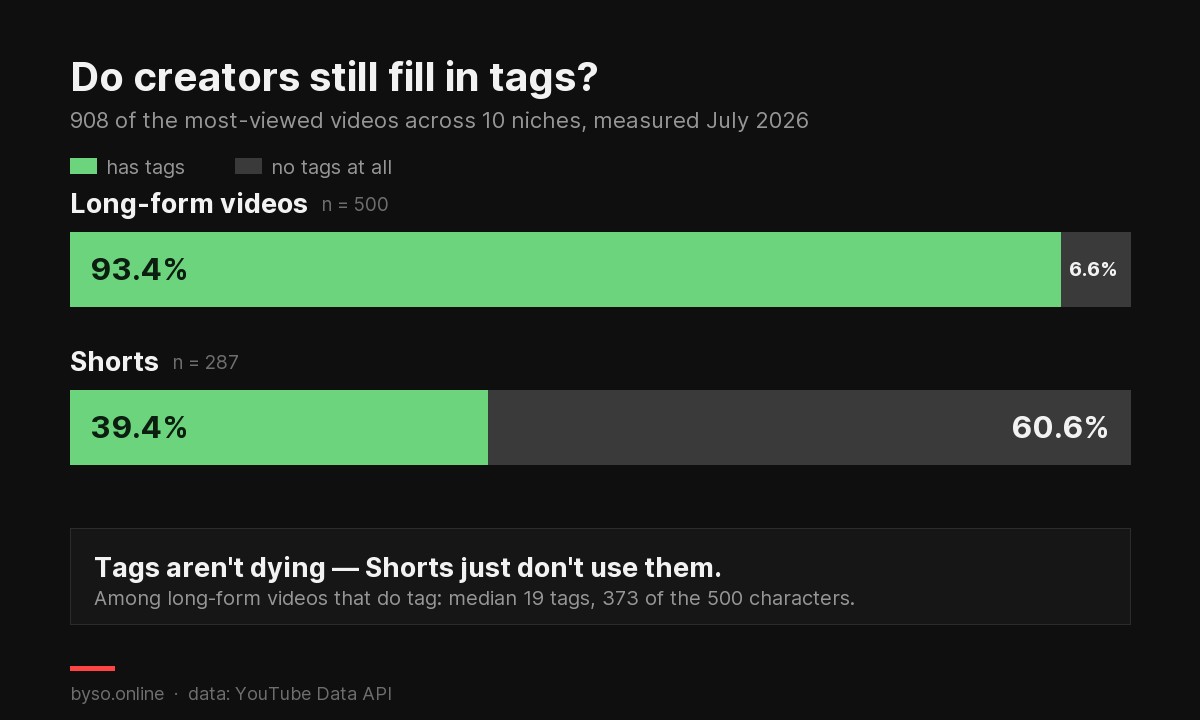
Long-form videos overwhelmingly still use tags. Only 6.6% of 500 had none. Among Shorts, 60.6% had none.
Why the gap? We measured the behaviour, not the reason, so treat what follows as the likeliest explanation rather than a finding: Shorts are usually published from the phone, where the tag field is buried, and Shorts discovery leans on the swipe feed rather than on search. The habit never formed. If you publish Shorts and have never touched a tag, you are in the comfortable majority — and if you want to know what actually drives Shorts, it's the cover frame, which we cover in our guide to custom Shorts thumbnails.
3How many tags a real video uses
Among long-form videos that use tags at all:
So the typical successful video is not using three careful tags — it is filling roughly three quarters of the allowance, and nearly four in ten push it to the brim. Whatever YouTube says about tags mattering little, creators behave as if they matter a lot.
At the same time, 15% of tagged videos used 100 characters or fewer. The range is enormous, which is itself the finding: there is no consensus practice, because there is no visible feedback telling anyone what works.
4The biggest videos break every rule
If tags were a meaningful lever, you would expect the largest videos to exploit them. They don't — in either direction.
| Channel | Views | Tags |
|---|---|---|
| LadyGagaVEVO | 1.78B | 4 tags · 39 chars |
| EvanescenceVEVO | 1.76B | 3 tags · 23 chars |
| MrBeast Gaming | 282M | none |
| Kurzgesagt – In a Nutshell | 25.9M | none |
| Chloe Ting | 63.6M | 33 tags · 500 chars |
Two of the most-watched videos on the platform use three or four tags. MrBeast's gaming channel and Kurzgesagt — two of the most deliberate operations on YouTube — shipped videos with none. And Chloe Ting maxes the field out completely. All of them work.
Across our sample there was no clean relationship between view count and tag usage in either direction. Whatever separates these videos, it isn't the tag field.
5Niches disagree with each other
Tag habits turn out to be cultural rather than strategic. Among long-form videos (n = 50 per niche):
| Niche | Median tags | No tags at all |
|---|---|---|
| Fitness | 25 | 4% |
| Science | 25 | 10% |
| Music | 21.5 | 0% |
| Beauty | 21 | 8% |
| DIY | 20 | 10% |
| Finance | 19 | 6% |
| Travel | 19 | 6% |
| Gaming | 15 | 6% |
| Cooking | 8.5 | 4% |
| Tech reviews | 8 | 12% |
Fitness creators use three times as many tags as tech reviewers. Every music video in the sample had tags, without exception — those are label uploads pushed through distribution systems that always populate metadata. None of this reflects a discovered truth about the algorithm. It reflects what people in each corner of YouTube copied from each other.
6Did creators abandon tags over time?
Barely. Among long-form videos, the share with no tags drifted from roughly 0–6% for videos published before 2021 to 10–14% in 2024–2026.
That is a real direction but a mild one, and the per-year sample sizes here are between 10 and 58 videos, with at least one year bucking the trend entirely. Treat it as a drift, not a collapse. The "nobody uses tags anymore" claim you'll read elsewhere is describing Shorts and generalising it to the whole platform.
7So what does YouTube actually say?
This is the part most tag articles skip, even though it's a single sentence on a public help page. YouTube states that tags "play a minimal role in your video's discovery", and that they're mainly useful when your content is commonly misspelled.
The same page adds that adding excessive tags to your description is against the policies on spam and deceptive practices.
So we have a platform saying "this barely matters", and 93% of successful long-form creators filling in 19 tags anyway. The honest reading isn't that one side is wrong. It's that tags are cheap. Two minutes of work on something that might contribute a little is an easy trade — right up until it becomes twenty minutes of research on something YouTube has told you is marginal.
8What to actually do
- Spend two minutes, not twenty. Everything below fits in that budget. If tag research is taking longer than writing your title, the priorities are inverted.
- Write 10–20 tags that describe your video, starting with the exact phrase someone would search. That lands you near the median of what works, without the padding.
- Include the misspellings. This is the one use YouTube explicitly endorses. If your topic is a name, a product or a foreign word people mistype, put the wrong spellings in.
- Don't copy a competitor's tags. They describe their video. Read them to see how someone framed a topic, then write your own.
- Publishing a Short? Skip it. Six in ten popular Shorts have no tags at all. Put that time into the first two seconds and the cover frame instead.
- Fix the title and thumbnail first. They're the two things every piece of evidence — YouTube's statements, our data, common sense — agrees actually decide whether anyone clicks. Our guide to writing titles is the better place to spend the afternoon.
Want to see the real tags on any video — and how much of the 500-character budget they use? Our tag extractor reads them straight from YouTube's API, free and without a sign-up.
Open the tag extractor →9Where this study is limited
Worth stating plainly, because most "we analysed X videos" posts don't:
- The sample is popular videos — median 12M views for the long-form set. It says nothing about what a channel with 500 subscribers should expect.
- Search results were requested with English-language relevance, so the picture skews to English-speaking YouTube.
- The long-form pass covers 4–20 minute videos specifically. Very long content may behave differently.
- Everything here is descriptive. We measured what creators do, not what worked. Nothing in this data can tell you whether tags helped any of these videos.
- Tags are read through the Data API, which returns them for public videos even though the watch page no longer displays them. If a creator later edits their tags, our snapshot ages.
FAQ
Do YouTube tags actually matter in 2026?
YouTube's help page says they play a minimal role in discovery and are mainly useful for commonly misspelled topics. Our data shows creators ignore that almost universally — 93% of popular long-form videos still use them. Treat tags as two minutes of housekeeping, not a growth lever.
How many tags should I use?
The median popular long-form video that uses tags has 19 of them, filling 373 of 500 characters. But videos with over a billion views in our sample used 3–4 tags. Ten accurate tags beat thirty padded ones.
Why do most Shorts have no tags?
60.6% of Shorts in our sample had none, against 6.6% of long-form. We measured the behaviour, not its cause — but the likeliest reason is that Shorts get published from the phone, where the field is buried, and their discovery leans on the swipe feed rather than search.
Is the 500-character limit per tag or total?
Total, across all tags. Commas count, and a tag containing a space is treated as if quoted — so those quotation marks count too. "Foo-Baz" costs 7 characters; "Foo Baz" costs 9.
Should I copy tags from a competitor?
No. Tags describe your own video, so a copied list adds nothing, and stuffing them runs against YouTube's spam policy. Read them for research, then write your own.
Next: tags are the smallest lever on this list. The two that aren't are your title and your thumbnail — and you can check how yours holds up next to real competitors with our free thumbnail preview tool. To see where a specific video stands against every documented rule at once, including the chapter requirements that fail silently, run it through our video SEO checker.