YouTube's Algorithm Director Just Debunked 6 Creator Myths
Published 1 Sep 2026YouTube put Todd Beaupré, its senior director of growth and discovery, in front of a camera for 39 minutes to explain how the recommendation system actually ranks videos. Several of his answers directly contradict advice creators pass around as fact.
If you read one paragraph: your subscribers do not decide your video's fate — the system learns from each audience separately, and a ~10% click-through rate in the subscriptions feed is normal even on your best work. Turning off comments doesn't penalise you. Unchecking "notify subscribers" is advised against. And the first hour matters far less than creator folklore says.
1"The algorithm pushes your video" — it doesn't
The mental model most creators carry is: you upload, then YouTube takes your video and pushes it out to some number of people. Beaupré's correction is that, notifications aside, recommendations work the other way round.
"Most of the recommendations are more pulled for each viewer… when a viewer opens their app or turns on their TV, that's when the recommendation system is activated for that viewer. And the decisions that the recommendation system makes are generated at that moment." Todd Beaupré · 1:18 in the interview
The practical consequence is that there is no single ranking for your video. The system doesn't look at a video and decide who its audience is; it looks at a viewer and decides which videos suit them right now — including what time it is and which device they're on.
"Each viewer gets a different ranking for each video… we're not really looking at a video and saying, 'Let's go figure out who the audience is going to be.' It's looking at each viewer and saying, 'What are the best videos for this viewer at this moment.'" Todd Beaupré · 2:07
2Your subscribers do not decide your video's fate
This is the most consequential myth in the interview, and the one that drives the most self-defeating behaviour. The belief: YouTube shows a new upload to your subscribers first, and if they don't bite, the video is finished.
Beaupré rejects both halves. First, subscribers aren't the only early audience:
"I've looked at channels and I see that the majority of their audience can be non-subscribers. And even in the first hour, videos are reaching people who've never watched the channel before." Todd Beaupré · 4:14
Second — and this is the part worth internalising — the system doesn't collapse everyone's reaction into one verdict. It learns per audience:
"It can learn that for subscribers this video is not performing well, and for people who haven't watched the channel, it is. So this worry that 'if my subscribers don't like it, then YouTube's going to decide for everyone that it's not a good video' — first, it's not only your subscribers who will see it, and two, the algorithm really wants to know what's best for each viewer, not just based on an overall aggregate opinion." Todd Beaupré · 4:51
What this invalidates: the widespread tactic of unchecking Notify subscribers to "protect" a video from a weak early reaction. Beaupré addresses it directly at 34:38: "I wouldn't advise people to turn off notifying subscribers… if you uncheck that box, I feel like you're not allowing the system to connect with a subset of viewers who are going to be interested."
3A 10% click-through rate in your subs feed is normal
The single most quotable number in the interview, and the one most likely to change how you read your own analytics. Beaupré suggests opening the subscriptions-feed traffic source and looking at its CTR:
"Probably all your videos have about maybe a 10% or less click-through rate. That means that even your best videos, 90% of the time your subscribed audience isn't deciding to watch… It's normal for an audience that has been interested in your channel to not be interested in every upload." Todd Beaupré · 36:48
He goes further, and says the plain thing about what a subscription is worth as a signal:
"The signal of subscribe isn't as strong as a lot of people think, because it doesn't mean I'm going to watch it 100%. It might mean I'm going to watch it 10%." Todd Beaupré · 37:10
The genuinely useful trick hidden in this section
Buried in the same answer is the best practical tip in the whole interview. The subscriptions feed is the one traffic source where the audience doesn't change between videos — it's always your subscribers. That makes it a control group.
"It does give you one slice of metrics that is not primarily influenced by an algorithm… if you see that people are clicking less, it's probably something to do with the content and not who the video was targeted to, because the targeting isn't changing. So yes, that's kind of a clean way to isolate the content from the algorithm." Todd Beaupré · 35:49
In Studio: Analytics → Advanced mode → Traffic source → Browse features, then expand to the subscriptions feed. Compare CTR there across your videos. Movement in that number is about your title and thumbnail, not about the algorithm's mood.
If that comparison says your covers are the problem, this is the cheap fix: drop a thumbnail into a real YouTube grid and see whether it survives next to competitors. Free, no sign-up, your image never leaves the browser.
Test a thumbnail in the feed →4Turning off comments or ads doesn't penalise you
Creators regularly worry that disabling comments reads to the system as "nobody engaged with this." Beaupré says that case was designed for explicitly:
"When we started looking at integrating comments, it was very important to us that we didn't penalise people that for whatever reasons choose not to have comments on. We don't want the system to understand that to mean like people just aren't engaging with this content." Todd Beaupré · 15:01
The same logic covers turning ads off. The underlying principle is that no single factor decides a ranking — which is also the answer to "which metric matters most?"
5There is no single metric, and the weights aren't fixed
Asked which metric carries the most weight, Beaupré's answer is that the question itself doesn't have a stable answer:
"The system doesn't even work that there's a weighting for each of these that is the same for everyone. It actually doesn't even work such that it's the same for you at all times… Maybe on television the time you spend might be more or less important than what you click on, versus on mobile maybe it's whether you like or dislike, because that's easier to do on mobile." Todd Beaupré · 12:50
What the system is aiming at, in his framing, is long-term value: viewers feeling that YouTube is worth returning to, sustained over years. Views, CTR, watch time, surveys, likes, dislikes and comments are all inputs, and he's explicit that time spent is not automatically value — which is why satisfaction surveys exist alongside the behavioural numbers.
One mechanical detail from this section explains a confusion many creators hit:
"The more impressions something gets, the broader the audience is reached, and that tends to make those aggregates look lower than if you're only targeting just the core fans." Todd Beaupré · 11:05
In other words: a falling CTR on a video that's taking off is the expected shape of success, not evidence of a problem. The video is being shown beyond your core audience, and that audience clicks less by definition.
6Off-topic suggested traffic is a feature, not a misfire
Creators open the Suggested traffic report, see unrelated channels, and conclude the algorithm has misunderstood them. Beaupré says watch-page recommendations stopped being purely topical a long time ago:
"The reason that a video can appear next to another video is not simply just because it's related… They're not related because it's the same topic, but they're connected because there was a viewer that watched both videos." Todd Beaupré · 29:04
And a statistic that quietly reorders how you should think about subscribers:
"The number one place that people are watching videos from channels they're subscribed to is actually on the watch page in that suggested list… that's actually quite small relative to the people who just see something from a channel they're interested in while they're watching a different channel." Todd Beaupré · 29:35
Your subscribers mostly do not find you through the subscriptions feed. They find you in the sidebar of someone else's video.
The mental model worth stealing
René Ritchie offers the cleanest reframe in the interview, and it applies to most algorithm anxiety:
"Puddles don't cause rain… people think that YouTube is pushing longer videos now, but people are watching on television and they want longer videos. And so YouTube is recommending those longer videos. YouTube isn't pushing them." René Ritchie · 16:03
Beaupré confirms the direction of causation: the growth in both long-form and very short video is a response to what viewers do, driven partly by decision fatigue — people don't want choosing what to watch to feel like work.
Myths and what was actually said
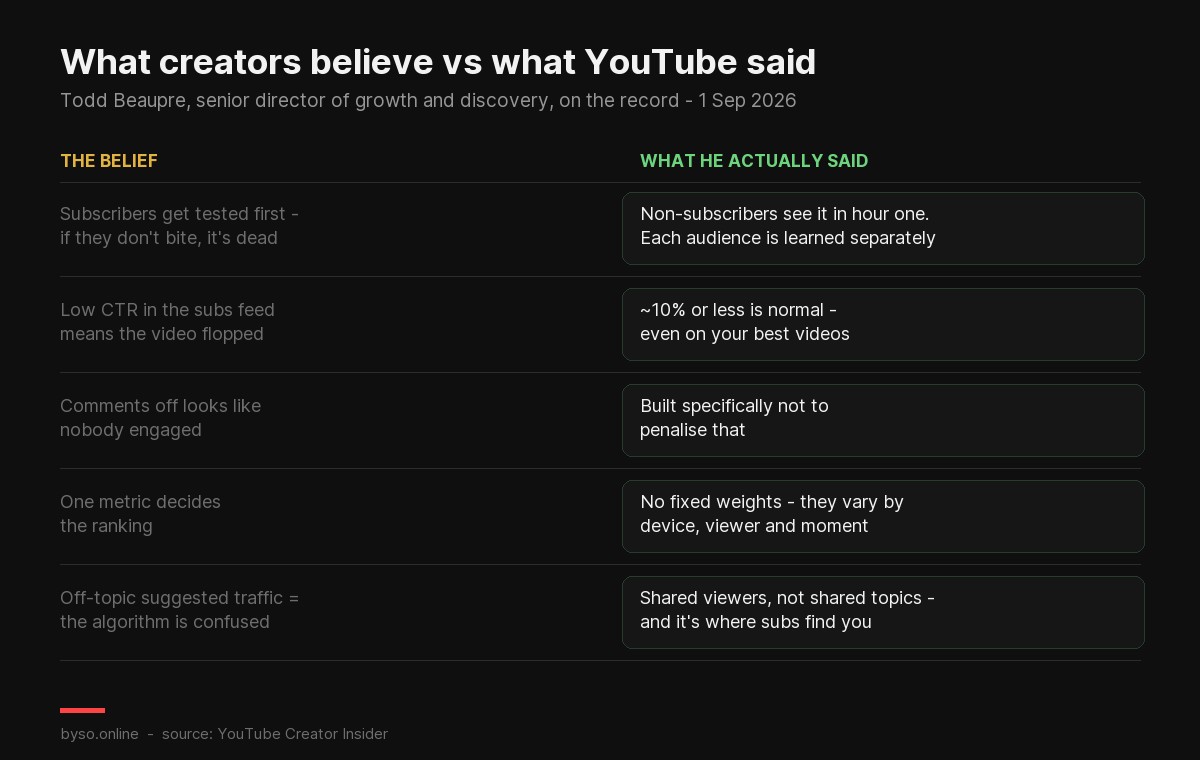
| What creators believe | What YouTube's director said |
|---|---|
| The algorithm pushes my video to N people | Recommendations are pulled per viewer, generated when they open the app |
| Subscribers get tested first; a weak start kills it | Non-subscribers see it in hour one; each audience is learned separately |
| Low subs-feed CTR means the video failed | ~10% or less is normal — even on your best videos |
| Comments off = looks like no engagement | Explicitly designed not to penalise that |
| One metric rules the ranking | No fixed weights; they vary by device, viewer and context |
| Off-topic suggested traffic = the algorithm is lost | Shared viewers, not shared topics — and it's where subs actually find you |
One honest caveat. This is YouTube describing its own system, in a video YouTube published. It's the best kind of source available — a named senior director, on the record, being specific — but it is not independent verification, and none of it can be tested from outside. We've quoted rather than paraphrased for exactly that reason: what's above is what he said, not our reading of what the algorithm does.
What to actually change on Monday
- Stop unchecking "notify subscribers." The stated rationale for doing it — protecting a video from a bad first impression — isn't how the system works.
- Stop reading the first two hours. Beaupré notes evergreen videos routinely take a month or more to collect most of their views, and the system keeps looking for an audience.
- Use the subs feed as your control group. It's the one place where the audience is constant, so CTR changes there point at your packaging.
- Stop panicking about a dropping CTR on a video that's growing. Broader reach mechanically lowers the aggregate.
- Judge new topics on their own scale. His analogy: a sushi restaurant opening a pasta place shouldn't expect day-one success — and neither should you expect your best-ever numbers from a first attempt at a new subject.
Sources
Everything above is quoted from a single primary source: "YouTube Algorithm 2026 — What Creators Need to Know", published on the official Creator Insider channel on 1 September 2026 — a 39-minute conversation between creator liaison René Ritchie and Todd Beaupré, YouTube's senior director of growth and discovery. Timestamps in each quote link to the exact moment. Quotes are lightly cleaned of filler words; wording and meaning are unchanged.
FAQ
Does YouTube test your video on subscribers first?
No. Videos reach diverse audiences from the first hour, including people who've never watched the channel, and for many channels the majority of the audience is non-subscribers. The system learns separately per audience, so a weak subscriber reaction doesn't decide the video's fate for everyone.
What is a normal click-through rate in the subscriber feed?
Around 10% or less, per YouTube's growth and discovery lead. Even on your best videos, roughly 90% of subscribers who see it choose not to watch — and he calls that normal.
Does turning off comments hurt your video in the algorithm?
No. YouTube says the system was deliberately built not to read disabled comments as an absence of engagement. The same applies to turning ads off.
Should you uncheck notify subscribers when uploading?
YouTube's director advises against it. Because each audience is learned separately, suppressing the notification only removes viewers who might have been interested — it doesn't shield the video.
Why does the algorithm recommend my video next to unrelated topics?
Watch-page recommendations aren't limited to related videos. Two videos can appear together because the same viewer watched both. That suggested list is also the number one place people watch videos from channels they subscribe to.
Does the algorithm push videos to viewers?
Mostly no. Apart from notifications, ranking is generated when a viewer opens the app, based on their history and context. Each viewer gets a different ranking of the same video.